
Your Phone Isn't a Focus Tool. It's the Biggest Threat to Your Focus.
The ClarityDial wasn't designed on a whiteboard. It was built on a body of peer-reviewed research spanning cognitive psychology, behavioral science, and attention economics.
The Cost of a Single Notification
In 2008, Gloria Mark and her team at UC Irvine measured what actually happens when knowledge workers get interrupted. The finding: it takes an average of 23 minutes and 15 seconds to fully return to the original task after a single interruption.
But the damage doesn't stop at lost time. Interrupted workers experienced significantly higher stress, frustration, and mental workload. After an interruption, participants completed an average of two entirely different tasks before returning to the original one. The interruption didn't just pause focus — it shattered the task sequence.
Every time you glance at your phone timer and see a notification badge, an unread message, or a social media alert, you reset the 23-minute clock. Your phone-based timer isn't helping you focus. It's systematically destroying it.
Your Phone's Mere Presence Drains Your Brain
In 2017, researchers at the University of Texas at Austin demonstrated that the mere presence of your own smartphone — even when it's face down, on silent, and powered off — measurably reduces your available cognitive capacity. Participants who left their phones in another room significantly outperformed those who had their phones on the desk or in their pockets, on tests of working memory and fluid intelligence.
The implication is stark: your phone doesn't need to ring, buzz, or light up to damage your focus. Simply knowing it exists within reach occupies a portion of your limited working memory.
A separate 2015 study by Stothart et al. confirmed a parallel finding: receiving a phone notification that you don't even check produces the same magnitude of performance disruption as actively picking up the phone and responding to a text message. The distraction is triggered by awareness alone.
The Start Trigger: How a Physical Dial Changes Your Brain State
In 1999, NYU psychologist Peter Gollwitzer published one of the most influential findings in behavioral science: when people form what he called an "implementation intention" — a specific if-then plan linking a situational cue to a desired action — their goal completion rates roughly tripled compared to those who simply held a goal intention ("I want to work for an hour").
The physical rotation of the ClarityDial creates exactly this mechanism. "When I twist the dial, I start working" becomes a pre-committed if-then contract between you and your prefrontal cortex. Instead of facing the ambiguous moment of "I should probably start now," your nervous system receives a clear, unambiguous start signal.
Procrastination isn't laziness — it's trigger failure. The nervous system avoids initiating action when the task feels uncertain or the start point is vague. The dial removes that uncertainty with a concrete physical gesture that your brain can anchor to. The twist is the trigger. The countdown is the commitment.
Structured Time Blocks Outperform Willpower
A 2025 scoping review published in BMC Medical Education systematically analyzed 32 studies with a combined sample of 5,270 participants to evaluate the efficacy of structured time intervals (including the Pomodoro Technique and its variants) on focus, productivity, and mental fatigue.
The findings were consistent across study designs: time-structured intervals reliably improved sustained attention, reduced perceived mental fatigue, and enhanced task performance compared to self-paced or unstructured work sessions. Students in structured break conditions reported being more concentrated, more motivated, and perceived tasks as significantly less difficult.
The research confirms what the ClarityDial is built around: external time structure isn't a productivity hack — it's a cognitive support system. When your brain knows a break is coming, it allocates attention more efficiently within the block.
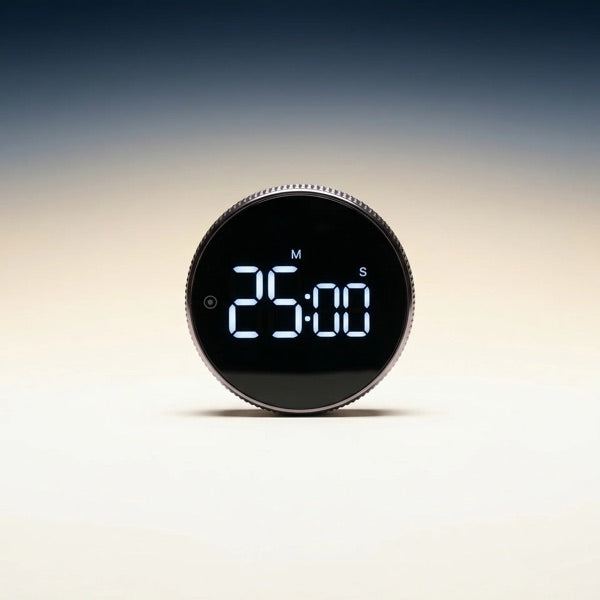
Remove the distraction. Install the trigger.
The ClarityDial replaces your phone timer with a standalone physical device backed by decades of cognitive research. Try it risk-free for 30 days.
No subscription required · Cancel-free
References
- Mark, G., Gudith, D., & Klocke, U. (2008). “The Cost of Interrupted Work: More Speed and Stress.” Proceedings of the SIGCHI Conference on Human Factors in Computing Systems (CHI '08), ACM.
- Ward, A.F., Duke, K., Gneezy, A., & Bos, M.W. (2017). “Brain Drain: The Mere Presence of One’s Own Smartphone Reduces Available Cognitive Capacity.” Journal of the Association for Consumer Research, 2(2), 140–154.
- Stothart, C., Mitchum, A., & Yehnert, C. (2015). “The Attentional Cost of Receiving a Cell Phone Notification.” Journal of Experimental Psychology: Human Perception and Performance, 41(4), 893–897.
- Gollwitzer, P.M. (1999). “Implementation Intentions: Strong Effects of Simple Plans.” American Psychologist, 54(7), 493–503.
- BMC Medical Education (2025). Scoping review assessing the efficacy of the Pomodoro technique across 32 studies (N = 5,270).